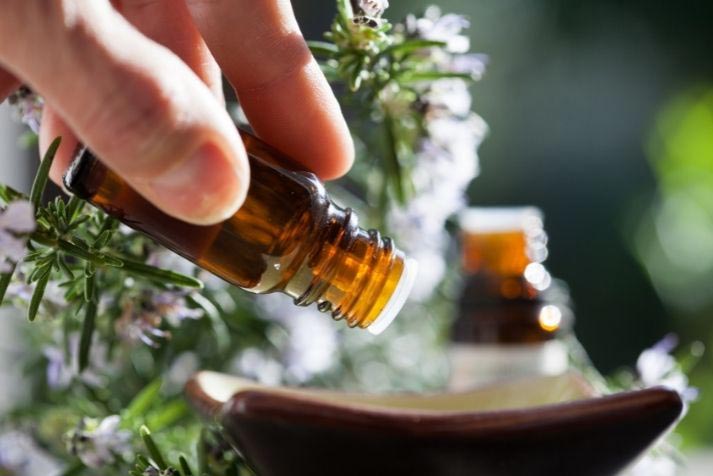
In emergency situations involving wounds, fractures, bleeding, or open injuries, essential oils may be used as complementary support to help maintain cleanliness, ease discomfort, and support the skin’s natural repair processes.
Aseptic care and cleansing with essential oils
Before addressing a wound, it is essential to gently cleanse the area with soapy water and remove any debris such as sand, dirt, or small stones. Once this initial cleansing has been completed, certain essential oils are traditionally used to help support surface hygiene.
Tea tree essential oil (Melaleuca alternifolia) is particularly well known in aromatherapy for this purpose. It is traditionally valued for its thoroughly cleansing and antibiotic properties and may also provide a soothing, analgesic sensation upon application. Due to its potency, it is recommended for adults and children over the age of seven.
WHAT TO DO: Apply 1 - 3 drops of undiluted tea tree essential oil directly to the cleansed wound, in a quantity appropriate to the area. In many cases, a single application is sufficient.
Bleeding and surface support: traditionally used hemostatic essential oils
Bleeding should never be stopped too soon, as it is also a way of removing any dust and microbes that may have penetrated deep into the wound. In any case, once the ‘cleaning’ is complete, there is an essential oil that can actually seal the wound and even initiate the healing process. This is Cistus essential oil (Cistus ladaniferus).
WHAT TO DO: Apply 1 - 2 drops of Cistus essential oil directly to the bleeding wound, applying light pressure for a few moments. This essential oil also relieves occasional nosebleeds by applying one drop to a small piece of cotton and placing it gently at the entrance of the nostril.
Essential oils for sprains, tears and bruises
In the event of trauma or bruising, the skin tends to turn blue very quickly, and the area swells as part of the body’s natural protective response. Blood cells gather at the site of the injury to repair and protect the tissue from possible infection. There is an essential oil that can be applied as quickly as possible to provide relief and also to support the body's inflammatory response and the formation of the haematoma. Helichrysum (also called Immortella) essential oil (Helichrysum italicum) has the power to repair all tissues that have lost their integrity: skin, muscles, tendons, ligaments, etc. So, for a fall, bruise, sprain, pinch, etc., the reflex that provides instant relief and repair is Helichrysum essential oil.
WHAT TO DO: Apply undiluted Helichrysum essential oil to the injured area as quickly as possible, using one drop or more if the surface area requires it. Repeat every 10 to 15 minutes, 5 or 6 times in a row if the pain is still present, spacing out applications according to the speed of improvement. For adults and children over 4 years of age only.
In the case of open wounds, this essential oil is not contraindicated but may cause stinging. Therefore, avoid applying it directly to the wound; tea tree essential oil, which is analgesic and antiseptic, is preferable.
To complement these guidelines, you may find this article helpful: Emergency and recovery gestures in aromatherapy for sprains.
Burns and essential oils
In the case of burns, rapid and appropriate action is essential. The severity of a burn depends on its size and location. Burns affecting an area larger than the palm of the hand, or involving sensitive zones such as the face or mucous membranes, must always be considered severeand require medical assistance.
In aromatherapy, lavender essential oils are traditionally used to support skin comfort following minor burns. Spike Lavender essential oil (Lavandula latifolia spica) is considered the most effective painkiller in this respect, but if this is not available, Fine Lavender essential oil (Lavandula angustifolia) can be used als an alternative. These essential oils have the ability to repair skin tissue and, in the case of spike lavender, to provide immediate pain relief. The healing process is facilitated and accelerated.
WHAT TO DO: After cooling the burn 10 minutes under water at 10 degrees (50 degrees Fahrenheit), apply a sufficient amount of UNDILUTED Spike lavender essential oil (a couple of drops should be enough). Do not use vegetable oil. Repeat every 10 to 15 minutes, up to five or six times, spacing applications as improvement is observed.
To further complement these emergency care guidelines, you may also read:
How to support insect or jellyfish stings with essential oils.
Examples of studies and articles
Youn BH, et al. Antimicrobial and hand hygiene effects of Tea Tree Essential Oil disinfectant: A randomised control trial. Int J Clin Pract. 2021 Aug;75(8):e14206. doi: 10.1111/ijcp.14206. Epub 2021 Jun 6. PMID: 33950544.
Carson CF, Hammer KA, Riley TV. Melaleuca alternifolia (Tea Tree) oil: a review of antimicrobial and other medicinal properties. Clin Microbiol Rev. 2006 Jan;19(1):50-62. doi: 10.1128/CMR.19.1.50-62.2006. PMID: 16418522; PMCID: PMC1360273.
Pazyar N, et al. A review of applications of tea tree oil in dermatology. Int J Dermatol. 2013 Jul;52(7):784-90. doi: 10.1111/j.1365-4632.2012.05654.x. Epub 2012 Sep 24. PMID: 22998411.
Thomsen PS, et al. Survey of the antimicrobial activity of commercially available Australian tea tree (Melaleuca alternifolia) essential oil products in vitro. J Altern Complement Med. 2011 Sep;17(9):835-41. doi: 10.1089/acm.2010.0508. Epub 2011 Aug 19. PMID: 21854197.
Want to Learn some Simple gestures in emergency cases?
Join my course today, and discorver the practical gestures in aromatherapy thant can be integrated in daily life!
Sala A, et al., Anti-inflammatory and antioxidant properties of Helichrysum italicum. J Pharm Pharmacol. 2002 Mar;54(3):365-71. doi: 10.1211/0022357021778600. PMID: 11902802.
Pekmezci E, Türkoğlu M. The Effects of Helichrysum italicum Extract on the Extracellular Matrix of the Skin. Acta Med Acad. 2023 Dec;52(3):182-187. doi: 10.5644/ama2006-124.425. PMID: 38407084; PMCID: PMC10945318.
Serra D, et al., Effect of Helichrysum italicum in Promoting Collagen Deposition and Skin Regeneration in a New Dynamic Model of Skin Wound Healing. Int J Mol Sci. 2024 Apr 26;25(9):4736. doi: 10.3390/ijms25094736. PMID: 38731954; PMCID: PMC11083432.
Maksimovic S, et al. Towards a modern approach to traditional use of Helichrysum italicum in dermatological conditions: In vivo testing supercritical extract on artificially irritated skin. J Ethnopharmacol. 2023 Jan 30;301:115779. doi: 10.1016/j.jep.2022.115779. Epub 2022 Oct 3. PMID: 36202166.
Süntar I, et al. Exploration of the wound healing potential of Helichrysum graveolens (Bieb.) Sweet: isolation of apigenin as an active component. J Ethnopharmacol. 2013 Aug 26;149(1):103-10. doi: 10.1016/j.jep.2013.06.006. Epub 2013 Jun 11. PMID: 23764736.
Margaux Degrelle. Les hélichryses (ou immortelles) en aromathérapie: zoom sur l’Hélichryse italienne
corse. Sciences pharmaceutiques. 2015. hal-01731734, https://hal.univ-lorraine.fr/hal-01731734v1
Cheryl Lynn Hewitt, Cistus: Therapeutic Actions and Potential Uses, January 2024, DOI:10.13140/RG.2.2.27471.05280
Cavanagh HM, Wilkinson JM. Biological activities of lavender essential oil. Phytother Res. 2002 Jun;16(4):301-8. doi: 10.1002/ptr.1103. PMID: 12112282.
Samuelson R, et al. The Effects of Lavender Essential Oil on Wound Healing: A Review of the Current Evidence. J Altern Complement Med. 2020 Aug;26(8):680-690. doi: 10.1089/acm.2019.0286. Epub 2020 Jun 24. PMID: 32589447.
Mori HM, Kawanami H, Kawahata H, Aoki M. Wound healing potential of lavender oil by acceleration of granulation and wound contraction through induction of TGF-β in a rat model. BMC Complement Altern Med. 2016 May 26;16:144. doi: 10.1186/s12906-016-1128-7. PMID: 27229681; PMCID: PMC4880962.
Yang Y, et al. A neural circuit for lavender-essential-oil-induced antinociception. Cell Rep. 2024 Oct 22;43(10):114800. doi: 10.1016/j.celrep.2024.114800. Epub 2024 Oct 3. PMID: 39365703.
Lucie Bressenot. La trousse à pharmacie version aromathérapie. Sciences pharmaceutiques. 2019.
HAL Id: hal-03297919, https://hal.univ-lorraine.fr/hal-03297919v1
Important information
Whenever we use the term ‘essential oils’ (EO), we always refer to essential oils that are 100% natural, 100% pure, 100% unadulterated, and preferably organic or wildcrafted. Only 100% genuine essential oils, obtained either by distillation or cold expression, are suitable for French aromatherapy. Proper storage and packaging, as well as adherence to the shelf life, are equally important in order to prevent the oxidation of aromatic molecules.
The information provided on this website is not intended as a substitute for professional medical advice, diagnosis, prescription or treatment. Essential oils are excellent complementary tools, but are not a replacement for medication. Aromatherapy is not recommended without medical advice for anyone in a fragile state (children, pregnant and breastfeeding women, people with allergies, asthma or epilepsy), or for anyone taking medication.
French aromatherapy requires strict compliance with contraindications, dosages and duration of use, and requires the use of essential oils of the best quality that meet standard criteria (method of cultivation, extraction, packaging, analysis and traceability). It is important to strictly adhere to the botanical and biochemical identifaction of the essential oils mentionned.
Individual tolerance to essential oils varies significantly, and it is important that each individual respects their own tolerance. For people with a low tolerance threshold, it is advisable to further dilute the essential oils listed in this recipe and the proposed synergies. Long-term use of essential oils requires medical advice.