According to the Traditional Chinese Medicine calendar, the first half of February marks the ideal time to “cleanse” the body of toxins accumulated over winter and begin a gentle spring detox. This practice exists in many traditional healing systems around the world. Essential oils can be powerful allies in supporting this natural process.
The Liver: A Key Organ in the Body’s Detoxification Process
The liver, a major detox organ
The body constantly ingests, metabolizes, assimilates, and eliminates a wide variety of substances. Metabolism is primarily managed by the liver, while elimination is largely supported by the kidneys. These two organs - known as emunctories, or detoxification organs - require particular care and support to function optimally over time.
The liver plays several vital roles: digestion of nutrients, synthesis of blood proteins, production of bile (stored in the gallbladder and essential for fat digestion), and detoxification. Detoxification involves transforming two types of toxins: exogenous toxins (from food breakdown, alcohol, and medications) and endogenous toxins generated by normal metabolic activity.
At the end of winter, when metabolism has slowed and fat storage has increased, the liver often becomes overloaded. Daily stress, reduced physical activity, winter fatigue, medications, and environmental toxins may further burden liver and kidney function. When these systems are overwhelmed, other emunctories - such as the intestines, lungs, and skin - step in. This can lead to signs of elimination, such as a blocked nose (not related to any ENT condition), spots, dull complexion, etc.
All of this points to a need for active support of the liver's detoxification function, to get off to a good start towards a dynamic and enterprising spring… the body and mind need to be freed from the unnecessary!
The term “detox” is often misused. In reality, detoxification is a continuous physiological process essential to maintaining balance. A “detox cure” is simply a supportive boost to these natural mechanisms.
Detox: for whom and how?
A detox program should be prepared thoughtfully, as it mobilizes metabolic energy and must be adapted to individual health status. Detox programs typically last from a few days up to three weeks.
To enhance the effectiveness of essential oils or medicinal plants, it is recommended to lighten the diet several days before beginning the detox and throughout the program. This frees digestive energy, allowing it to be redirected toward metabolic renewal. Reduced insulin secretion improves metabolic flexibility.
In addition, during periods of fasting:
- Cells eliminate oxidized proteins and dysfunctional organelles
- Intracellular toxic load decreases
This is one of the most scientifically sound arguments for fasting before undertaking any metabolic “cleansing” programme.
Listening to the body is essential. For some individuals, a few days may be sufficient. #
At first, detox treatments can cause some unpleasant symptoms (nausea, fatigue, spots, etc.), but these should not last long. They are then followed by a feeling of lightness and renewed energy!
For fragile or elderly individuals, detoxification should remain gentle and may simply include lighter meals, vegetable juices, herbal teas, and rest.
IMPORTANT: Detox programs are contraindicated for children, pregnant or breastfeeding women, individuals without a gallbladder, bile duct obstruction, intestinal obstruction, liver or kidney insufficiency, long-term medication use ((possible interference with drug metabolism). It is also not recommended in cases of chronic asthenia or depression. chronic fatigue, or depressive states.
Key detoxifying essential oils
Nature offers a wide range of aromatic plants that support liver detoxification, including lemon zest, rosemary ct. verbenone, lovage root, celery, labrador tea, carrot seed, and juniper.
Three approaches are possible. Choose the one best suited to your needs.
A simple daily gesture: lemon essential oil (Citrus limonum)
Lemon essential oil, obtained from the zest, is a digestive tonic that supports liver function. It has gentle cleansing and blood-fluidifying properties and provides immune stimulation.
How to use: 1 - 2 drops, 2 - 3 times per day, mixed with honey or a vegetable oil. Let it melt in the mouth before swallowing.
Specific contraindication: Do not use if undergoing anticoagulant therapy. Highly photosensitizing - if you apply it to the skin, avoid sun exposure for 8 hours.
Targeted detox support: lovage root essential oil (Levisticum officinalis)
Lovage is commonly used as a culinary herb: it is often found in ‘herb salts’. Its root yields a thick essential oil with a strong scent, which has depurative, detoxifying, and even anti-toxic properties. It acts on the liver and kidneys. It is particularly useful for cleansing the body after heavy and/or prolonged drug treatments. It is an unrivalled natural active ingredient for neutralising heavy metals. It has a slightly diuretic effect. It complements lemon essence or rosemary verbenone essential oil very well.
How to use: 1 - 2 drops, 2 - 3 times per day after meals. Mix thoroughly into one teaspoon of vegetable oil (olive, rapeseed, sesame) before oral use. Use for 7 days, adapting as needed.
Specific contraindication: avoid prolonged use without professional guidance. Photosensitizing: if applied on skin, avoid sun exposure for 8 hours.
Want to Learn some Simple gestures in emergency cases?
Join my course today, and discorver the practical gestures in aromatherapy thant can be integrated in daily life!
Note: Lemon and lovage essential oils may be combined, without exceeding a total of 1 - 2 drops per dose, 2 - 3 times daily.
Complete spring detox: essential oil synergy
If the signs of ‘clogging’ (nausea, slow digestion, bad breath, etc.) are significant and/or long-standing, a longer protocol with a synergy, i.e. a blend of essential oils that work in a complementary manner, is recommended.
In addition to lemon and lovage, carrot seed, rosemary verbenone and tarragon essential oils may be included. Carrot essential oil drains the liver and kidneys and purifies the skin and blood vessels. Rosemary verbenone essential oil is one of the most important essential oils for liver, gallbladder and pancreas health. It cleanses, rebalances the hormonal system as a whole and deeply revitalises. Read this article for more information on the different rosemary essential oils.
FORMULA
Spring Detox Essential Oil Synergy
| EO Lemon (Citrus limonum) | 4 ml |
| EO Lovage root (Levisticum officinale) | 2 ml |
| EO Carrot seed (Daucus carota) | 1 ml |
| EO Rosemary verbenone (Rosmarinus officinalis ct verbenone or Salvia rosmarinus ct. verbenone) | 3 ml |
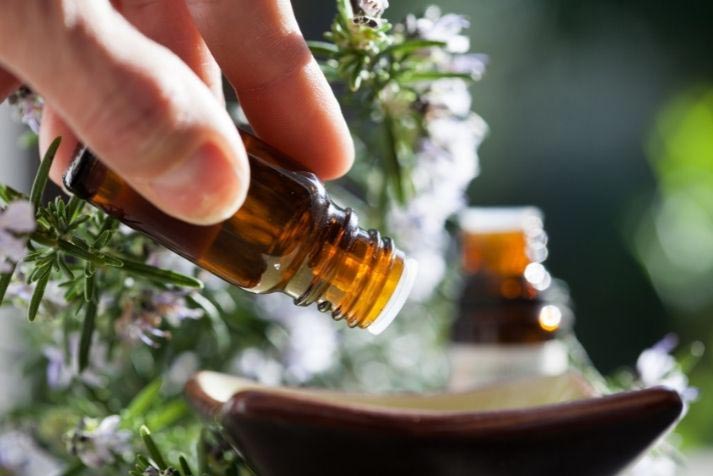
Prepare the blend in a 10 ml amber glass bottle with dropper. Take 2 drops of the synergy morning and evening after meals, mixed into one teaspoon of vegetable oil (olive or rapeseed). Hold in the mouth briefly before swallowing. Use for a few days up to 3 weeks, depending on individual response.
Specific contraindications: anticoagulant therapy, long-term medication use, bile duct obstruction, depressive or asthenic states, history of hormone-dependent cancers. Avoid prolonged use without professional guidance.
Expected benefits: Radiant complexion, clear skin, vitality and clarity of mind, healthy scalp, deep sleep, regular bowel movements, supple and soothed joints, improved metabolism and even slight weight loss.
To supplement this article and provide you with additional information, you can follow the recommendations in the AMSOAM article, Spring Detox Cure: Naturopathic Advice, Hydrolats and Liver Massage.
Examples of studies and articles on this topic
Spréa RM et al., Chemical and bioactive characterization of the aromatic plant Levisticum officinale W.D.J. Koch: a comprehensive study. Food Funct. 2020 Feb 26;11(2):1292-1303. doi: 10.1039/c9fo02841b. PMID: 31998909.
Afarnegan H, Shahraki A, Shahraki J. The hepatoprotective effects of aquatic extract of Levisticum officinale against paraquat hepatocyte toxicity. Pak J Pharm Sci. 2017 Nov;30(6(Supplementary)):2363-2368. PMID: 29188770.
Mohamed ME, Younis NS, El-Beltagi HS, Mohafez OM. The Synergistic Hepatoprotective Activity of Rosemary Essential Oil and Curcumin: The Role of the MEK/ERK Pathway. Molecules. 2022 Dec 15;27(24):8910. doi: 10.3390/molecules27248910. PMID: 36558044; PMCID: PMC9781795.
Murali R, Karthikeyan A, Saravanan R. Protective effects of D-limonene on lipid peroxidation and antioxidant enzymes in streptozotocin-induced diabetic rats. Basic Clin Pharmacol Toxicol. 2013 Mar;112(3):175-81. doi: 10.1111/bcpt.12010. Epub 2012 Oct 25. PMID: 22998493.
Gu M, et al. The gastrointestinal fate of limonin and its effect on gut microbiota in mice. Food Funct. 2019 Sep 1;10(9):5521-5530. doi: 10.1039/c9fo01274e. Epub 2019 Aug 16. PMID: 31418448; PMCID: PMC6751002.
Yan Li et al, The Chemical Composition and Antibacterial and Antioxidant Activities of Five Citrus Essential Oils. Molecules 2022, 27, 7044. https://doi.org/10.3390/molecules27207044
Wasim M, et al. Verbenone prevents cyclophosphamide-induced oxidative stress, inflammation, fibrosis, and cellular changes in the kidneys of Swiss albino mice by targeting NF-ĸB/TGF-β signaling pathways. Iran J Basic Med Sci. 2025;28(8):1119-1128. doi: 10.22038/ijbms.2025.83541.18091. PMID: 40584449; PMCID: PMC12203825.
Bouzenna H, et al. The protective effect of Citrus limon essential oil on hepatotoxicity and nephrotoxicity induced by aspirin in rats. Biomed Pharmacother. 2016 Oct;83:1327-1334. doi: 10.1016/j.biopha.2016.08.037. Epub 2016 Aug 27. PMID: 27571876.
Klimek-Szczykutowicz M, et al. Citrus limon (Lemon) Phenomenon-A Review of the Chemistry, Pharmacological Properties, Applications in the Modern Pharmaceutical, Food, and Cosmetics Industries, and Biotechnological Studies. Plants (Basel). 2020 Jan 17;9(1):119. doi: 10.3390/plants9010119. PMID: 31963590; PMCID: PMC7020168.
Important Information
Whenever we use the term ‘essential oils’ (EO), we always refer to essential oils that are 100% natural, 100% pure, 100% unadultary, and preferably organic or wildcrafted. Only 100% genuine essential oils, obtained either by distillation or cold expression, are suitable for French aromatherapy. Proper storage and packaging, as well as adherence to the shelf life, are equally important in order to prevent the oxidation of aromatic molecules.
The information provided on this website is not intended as a substitute for professional medical advice, diagnosis, prescription or treatment. Essential oils are excellent complementary tools, but are not a replacement for medication. Aromatherapy is not recommended without medical advice for anyone in a fragile state (children, pregnant and breastfeeding women, people with allergies, asthma or epilepsy), or for anyone taking medication.
French aromatherapy requires strict compliance with contraindications, dosages and duration of use, and requires the use of essential oils of the best quality that meet standard criteria (method of cultivation, extraction, packaging, analysis and traceability). It is important to strictly adhere to the botanical and biochemical identifaction of the essential oils mentionned.
Individual tolerance to essential oils varies significantly, and it is important that each individual respects their own tolerance. For people with a low tolerance threshold, it is advisable to further dilute the essential oils listed in this recipe and the proposed synergies. Long-term use of essential oils requires medical advice.